




Where are the best hidden waterfalls in Wisconsin? Search “Wisconsin waterfalls” and you’ll commonly see the same handful of results: Copper Falls, Amnicon, Big Manitou, Pewit’s Nest, and maybe Interstate Falls if the writer did a little extra homework. Those are genuinely worth visiting, but they’re also genuinely crowded on any warm weekend from May through October. I’m Norté, the voice behind Near and Unknown, and I’ve been chasing falls across this state long enough to know that the most rewarding ones are rarely the most Instagrammed.
Table Of Content
- Where Are the Best Hidden Waterfalls in Wisconsin, Northern Picks
- Lost Creek Falls near Cornucopia, WI
- Potato River Falls near Gurney, WI
- Houghton Falls Nature Preserve near Washburn, WI
- Where Are the Best Hidden Waterfalls in Wisconsin, Marinette County Finds
- Strong Falls at Goodman Park, Peshtigo River
- LaSalle Falls near Florence, WI
- Dave’s Falls and Veterans Falls near Amberg and Crivitz
- Southern Wisconsin’s quiet waterfall secret
- Parfrey’s Glen near Merrimac, WI
- Norté’s personal ranking: the falls that made my short list
- Best overall: why Lost Creek Falls wins
- Best for families: Veterans Falls and Dave’s Falls
- Best for photographers: LaSalle Falls
- What to know before you hike to any of these falls
- Best seasons for peak water flow in Wisconsin
- Parking, permits, and private land awareness
- Where are the best hidden waterfalls in Wisconsin? Plan your trip with Near and Unknown
- Frequently Asked Questions
- Where are the best hidden waterfalls in Wisconsin?
- What are the best secret waterfalls in Wisconsin for first-time visitors?
- When is the best time to visit Wisconsin waterfalls?
- Do any hidden Wisconsin waterfalls require permits?
- Related posts
This guide is built from actual visits, not recycled travel roundups. I’ll break the state into three zones: northern Wisconsin, the northeast corridor through Marinette County, and a southern option that most people overlook entirely. Each waterfall comes with GPS, trail details, and an honest read on difficulty. At the end, I’ll give you my personal short list so you know which falls are worth building a whole trip around and which ones are solid detour material.
The best Wisconsin waterfall hikes are the ones that don’t show up on page one. Here’s where to find them.
Where Are the Best Hidden Waterfalls in Wisconsin, Northern Picks
Northern Wisconsin holds a remarkable concentration of secret waterfalls that most visitors never find. Most of them sit within a reasonable drive of each other across Bayfield and Iron counties, think a few hours between trailheads, which makes a long weekend loop through that region one of the more rewarding waterfall road trips you can plan in the state. Pack an overnight bag and give yourself two days minimum.
Lost Creek Falls near Cornucopia, WI
This is my single favorite find in all of northern Wisconsin. Lost Creek Falls is a 15-foot curtain of water on Lost Creek, and one of the rare Wisconsin falls where you can actually walk behind the drop. The cool spray and filtered light make it the kind of place you’ll wonder why no one talks about. GPS: 46.834185°N, 91.12056°W.
The trail is approximately 2.2 miles round trip with minimal elevation change, which puts it squarely in easy-to-moderate territory for most hikers. Lost Creek Falls is roughly 341 miles from Milwaukee, plan it as part of a Bayfield overnight rather than a day trip. The town of Cornucopia is small but genuinely charming, and the combination of the falls, the town, and Lake Superior all within a few miles makes this one of the best full-day itineraries in the north.
Potato River Falls near Gurney, WI
Most first-time visitors to Potato River Falls are surprised by it. The Potato River appears to drop in two distinct stages, giving you a stacked waterfall experience that feels bigger than you’d expect this far off the beaten path. It sits in Iron County near the Michigan border, which means it pairs naturally with Lost Creek Falls as part of a longer northern loop. The walk from the parking area to the viewpoint is short, and the terrain is generally manageable for most visitors, though the area can be uneven in spots so check current trail conditions before you go.
Houghton Falls Nature Preserve near Washburn, WI
The trail here is only 0.75 miles, but the payoff is genuinely dramatic. The falls flow seasonally toward Lake Superior, and the trail ends at a bluff edge with views that extend far beyond the waterfall itself. Spring, specifically late April through May, is your window. By midsummer the flow often drops to nearly nothing. If you’re already in the Washburn area, this is an easy add-on, but don’t make a dedicated trip in July expecting a strong cascade.
Where Are the Best Hidden Waterfalls in Wisconsin, Marinette County Finds
Marinette County is the most underrated waterfall corridor in Wisconsin, and it isn’t even close. Most travelers pass through on the way to Michigan’s Upper Peninsula without stopping, which is honestly one of the more costly mistakes a Wisconsin traveler can make. The county has a mapped falls tour with more than ten accessible drops, ranging from roadside viewpoints to legitimate hiking destinations. Plan a full day here if you can.
Strong Falls at Goodman Park, Peshtigo River
Strong Falls is a 20-foot plunge on the Peshtigo River and one of the most rewarding easy hikes in the northeast. GPS: 45.51960°N, 88.34139°W. The trailhead sits inside Goodman Park, parking is straightforward, and a CCC-era stone shelter near the falls adds a layer of history that makes the stop feel complete rather than just scenic. If you’re introducing someone to Marinette County for the first time, this is where to start.
LaSalle Falls near Florence, WI
LaSalle Falls is a 20-foot slide fall on the Pine River, and it behaves differently than most Wisconsin drops. Rather than a clean plunge, the water moves across layered rock face before hitting the pool below, which gives photographers something genuinely interesting to work with. The approach is about a mile, with roughly half a mile of rapids feeding into the gorge before you reach the main falls. GPS: 45.8312°N, 88.29°W. This one rewards patience more than speed.
Dave’s Falls and Veterans Falls near Amberg and Crivitz
These two pair well as a single-day itinerary. Dave’s Falls (GPS: 45.49611°N, 87.98861°W) is a 15-foot drop on the Pike River, best visited in spring when the flow is at full strength. Veterans Falls near Crivitz (GPS: 45.267268°N, 88.213397°W) has a short, flat approach on the Thunder River and is very family-accessible, genuinely comfortable for kids and older adults alike. Both carry a $5 day-use fee per car under Marinette County’s park system.
Southern Wisconsin’s quiet waterfall secret
Southern Wisconsin isn’t waterfall country by reputation, but Parfrey’s Glen is a legitimate exception. It’s also a fundamentally different kind of experience than anything in the north, less about volume or drop height and more about being enclosed in a narrow canyon where the walls press close and the stream crossings give the walk a real sense of discovery.
Parfrey’s Glen near Merrimac, WI
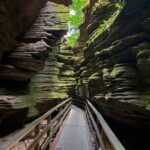
Wisconsin’s first State Natural Area is a narrow sandstone and quartzite canyon with a seasonal waterfall tucked at the far end of a 1.5-mile round-trip trail. GPS: 43.41863°N, 89.64178°W. The gorge walls close in as you hike deeper, and the stream crossings give the walk a sense of exploration that flat trail systems can’t replicate. Spring, from late April through May, delivers the strongest flow and the most dramatic atmosphere.
A few rules apply here that don’t exist at most other falls: pets are not allowed, and a Wisconsin State Park vehicle sticker is required to park. The lot fills on weekends, so arriving before 9 a.m. is a smart move. Parfrey’s Glen is a short drive from Devil’s Lake State Park, roughly ten minutes, which makes it an easy pairing for a full day in the Baraboo area.
Norté’s personal ranking: the falls that made my short list
Not every waterfall on this list is worth a special trip. Some are excellent detours if you’re already in the region. Here’s my honest take on which ones earn a dedicated drive.
Best overall: why Lost Creek Falls wins
No other Wisconsin waterfall I’ve visited combines the walk-behind experience, low crowd levels, and a genuinely interesting surrounding town the way Lost Creek Falls does. Even in summer, it rarely draws the kind of traffic you’d expect from a falls this special. If someone asks me for a single hidden falls WI hike to prioritize, this is the answer every time. Pair it with a night in Bayfield and you have one of the best short road trips in the Midwest.
Best for families: Veterans Falls and Dave’s Falls
Both falls offer short approaches, no serious elevation, and enough visual payoff to keep kids engaged. Veterans Falls earns the edge for families with very young children because the trail surface is the most forgiving of the two. Dave’s Falls is slightly more dramatic in spring, so if your kids are a bit older and can handle a little rougher terrain, it’s worth including both in the same day.
Best for photographers: LaSalle Falls
The slide-fall texture, the gorge framing, and the way the rapids lead your eye toward the main drop give LaSalle Falls more compositional range than almost any other fall in the northeast. Overcast spring days produce the flattest light and the most saturated rock color. This one rewards an early arrival and some patience with your angles.
What to know before you hike to any of these falls
A little planning prevents a wasted four-hour drive. These are the four things that actually matter for any Wisconsin waterfall trip.
Best seasons for peak water flow in Wisconsin
Spring is peak flow across essentially every Wisconsin waterfall hike, driven by snowmelt and spring rain from late April through early June. By late July, several falls run thin or go nearly dry, especially seasonal options like Houghton Falls. Fall offers stable flow and the bonus of foliage color on the surrounding trees. Winter visits to the Marinette County falls are possible, but icy rocks and unpredictable road conditions add real risk that most casual visitors should skip.
Parking, permits, and private land awareness
Most of the falls in this guide sit on public land with free or low-cost parking. The Marinette County falls carry a $5 day pass per vehicle, and Parfrey’s Glen requires a Wisconsin State Park sticker. Beyond this list, some Wisconsin falls involve private land corridors where access may or may not be permitted, always verify current access status before driving out to an unfamiliar site. None of the named falls in this guide currently require special permits, but land status can change. A quick search or call before you go takes two minutes and saves a wasted drive.
Where are the best hidden waterfalls in Wisconsin? Plan your trip with Near and Unknown
The answer runs across three distinct regions, each with its own character. In the north, you’ve got remote cascades tucked into Bayfield and Iron counties that most visitors never find. In the northeast, Marinette County delivers an underrated corridor of best small waterfalls WI travelers rarely put on their itineraries. And in the south, Parfrey’s Glen offers a canyon experience unlike anything else in the state. The falls covered here are all on public land, and none require special permits beyond the day-use fees and park stickers noted above, though it’s always worth confirming current conditions before you head out.
The falls worth seeking out are almost always the ones that take a little more effort to find. That’s not a cliché, it’s just how it works when you’re chasing secluded falls near me Wisconsin-style, off the standard travel lists, down the roads the GPS doesn’t always suggest. Near and Unknown covers off-the-beaten-path Wisconsin destinations year-round, including seasonal trail condition updates and new finds as I add them to the list.
Save this guide before your next road trip north. You’re going to want it when you’re standing at a trailhead in Cornucopia wondering which way to turn.
Frequently Asked Questions
Where are the best hidden waterfalls in Wisconsin?
The top hidden waterfalls in Wisconsin are spread across three regions: northern Wisconsin (Lost Creek Falls near Cornucopia, Potato River Falls near Gurney, and Houghton Falls near Washburn), northeast Wisconsin’s Marinette County (Strong Falls, LaSalle Falls, Dave’s Falls, and Veterans Falls), and southern Wisconsin (Parfrey’s Glen near Merrimac). Each offers a genuinely off-the-beaten-path experience with GPS coordinates and trail details in the guide above.
What are the best secret waterfalls in Wisconsin for first-time visitors?
Lost Creek Falls near Cornucopia is the top pick for first-timers, it’s an easy-to-moderate 2.2-mile round trip with a walk-behind feature that most people don’t know exists. Strong Falls in Marinette County is another excellent starting point, with straightforward parking and a short trail that delivers a full 20-foot plunge.
When is the best time to visit Wisconsin waterfalls?
Late April through early June is peak flow for most Wisconsin waterfall hikes, driven by snowmelt and spring rain. Some falls, like Houghton Falls, go nearly dry by midsummer. Fall is the second-best window for flow and offers strong foliage color. Winter visits are possible at some sites but carry real risk from icy trails and unpredictable road conditions.
Do any hidden Wisconsin waterfalls require permits?
The falls listed in this guide don’t require special hiking permits, but two do have entry fees. Marinette County parks, including Strong Falls, Dave’s Falls, LaSalle Falls, and Veterans Falls, charge a $5 day-use fee per vehicle. Parfrey’s Glen requires a Wisconsin State Park vehicle sticker. Always verify current access and fee status before your visit, as these details can change.